



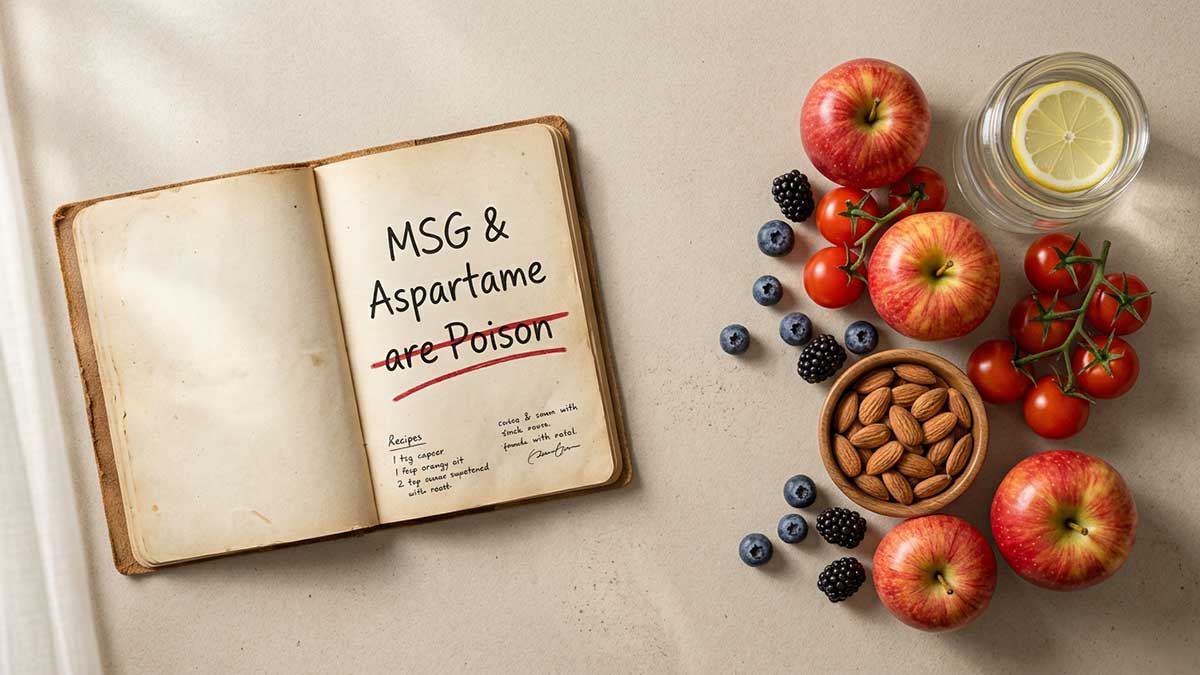
“You learn as long as you live, and a wise person is never ashamed to adapt their knowledge when science keeps moving forward.”
— The Galanto Club Team
Today we are doing something that few in our field dare to do publicly: we are pouring ourselves a glass of clear water, taking a deep breath, and admitting with a smile… that years ago we, too, used to scare people with certain things!
If you have read our earliest articles or talked to us some time ago, you have probably heard us speak with apprehension about “bad” monosodium glutamate (MSG), “poisonous” aspartame, and scary formaldehyde. But because at Galanto Club we view health as a constant evolution rather than a frozen dogma, over the past few years we have read tons of independent studies. And we realized it’s time to clean up our diet not only from excess calories, but also from… outdated myths!
1. Monosodium Glutamate (MSG): From Monster to… a Pinch of Umami
Remember the myth of “Chinese restaurant syndrome”? It turns out that this whole drama from the 1960s was driven more by urban legends and flawed tests than by actual biology.
What is the truth? Glutamate is simply an amino acid found quite naturally in ripe tomatoes, mushrooms, parmesan, and even in breast milk! For our stomach, there is absolutely no difference whether the glutamate comes from a ripe cherry tomato or a packet of seasoning. Global institutions such as the FDA (USA) and EFSA (Europe) have long been clear: MSG is completely safe. And by the way — it contains three times less sodium than regular table salt, so sometimes it can actually be your ally in the kitchen!
2. Aspartame and Formaldehyde: The Truth Behind the Chemical Scarecrows
“Don’t drink diet soda, it has aspartame in it that turns into formaldehyde in your body!” – admit it, you’ve heard this (maybe even from us).
What does biochemistry say? Yes, the breakdown of aspartame does release a tiny amount of methanol, which is converted into formaldehyde. Sounds scary, right? But did you know that when you eat an ordinary apple or drink a glass of tomato juice, your body receives significantly more methanol? Formaldehyde is a natural byproduct of our own cells at work, and our body neutralizes it in seconds. For aspartame to harm you, you would have to drink about 30 cans of diet soda every single day for years. (If you’re drinking 30 cans a day, aspartame will honestly be the least of your problems!)
Why do so many people (and businesses) still criticize them then?
It’s very simple: fear sells perfectly. For the industry, it is much easier to slap a “No MSG!” or “No Aspartame!” label and sell a product at double the price than to explain complex biochemistry. Here at Galanto Club, however, we prefer facts over marketing.
So… What Are the REAL Harmful Foods?
Now that we’ve cleared away the scarecrows, let’s talk about the things science 100% agrees on. If you want to invest in your health, here are the ingredients truly worth limiting:
- Industrial Trans Fats (Hydrogenated Oils): They are the true enemy of the heart and blood vessels. Found in cheap margarines, commercial pastries, and fried convenience foods.
- Excess Added Sugar and Sugar Syrups: The silent engine behind insulin resistance, fatty liver disease, and chronic inflammation.
- Processed Meats with Nitrites (E250/E251): Hot dogs, cheap salamis, and bacon. When thermally processed, they form compounds (nitrosamines) scientifically linked to an increased risk of colorectal cancer.
- Aflatoxins (Molds in Nuts): Invisible toxins that appear in poorly stored peanuts or dried fruits – highly toxic to the liver.
- Excess Table Salt: Sodium is vital, but chronic overconsumption leads to high blood pressure and kidney issues.
The Three Fundamental Principles of Galanto Club
- Eat Real, Wholesome Food: Focus on a variety of plants, quality fish, eggs, and clean meat. The fewer steps between nature and your plate, the better.
- Remember That the Dose Makes the Poison: A pizza or a can of soda won’t destroy your health, just as a single salad won’t make you an athlete. What matters is what you do 80% of the time.
- Free Yourself from Food Phobias: Eating should bring joy, energy, and social pleasure rather than constant stress and reading labels with a magnifying glass.
Thank you for walking this path of knowledge with us! Stay healthy, inspired, and enjoy every moment of your life.
📚 Bibliography and Scientific Sources
At Galanto Club, we believe every claim must stand on verified facts. Here are some of the key scientific opinions and meta-analyses upon which this article is based:
- European Food Safety Authority (EFSA) (2017).
Scientific Opinion on the re-evaluation of glutamic acid (E 620), sodium glutamate (E 621), potassium glutamate (E 622), calcium glutamate (E 623), ammonium glutamate (E 624) and magnesium glutamate (E 625) as food additives.
EFSA Journal, 15(7), 4911.[Official re-evaluation of glutamate safety in the EU] - U.S. Food and Drug Administration (FDA) (2012 / Updated 2023).
Questions and Answers on Monosodium glutamate (MSG).
FDA Center for Food Safety and Applied Nutrition.[Classification of MSG as GRAS – Generally Recognized As Safe] - European Food Safety Authority (EFSA) (2013).
Scientific Opinion on the re-evaluation of aspartame (E 951) as a food additive.
EFSA Journal, 11(12), 3496.[Full risk assessment and confirmation of aspartame safety] - WHO / FAO Joint Expert Committee on Food Additives (JECFA) (2023).
Summary of findings from the evaluation of aspartame.
World Health Organization & Food and Agriculture Organization.[WHO review and reaffirmation of the Acceptable Daily Intake (ADI)] - International Agency for Research on Cancer (IARC / WHO) (2018).
IARC Monographs on the Evaluation of Carcinogenic Risks to Humans: Red Meat and Processed Meat (Vol. 114).
World Health Organization.[Evidence on the carcinogenicity of processed meats and nitrite compounds] - Mozaffarian, D., Aro, A., & Willett, W. C. (2009).
Health effects of trans-fatty acids: experimental and observational evidence.
European Journal of Clinical Nutrition, 63(S2), S5-S21.[Impact of industrial trans fats on cardiovascular health]
