




Is a healthy lifestyle really expensive?
Is a healthy lifestyle really expensive? The truth behind the financial myth
“I want to eat healthy and exercise… but it’s too expensive for me.”
Have you heard this sentence? Maybe you’ve said it yourself?
Is a healthy lifestyle really expensive? This is one of the most popular myths we encounter in the Wellness Compass GT program. The truth is that behind it most often lies not so much a lack of funds as a lack of information and the wrong arrangement of priorities.
Of course, if we compare a quick lunch menu of greasy banitsa or a slice of pizza with a soft drink, versus a salmon fillet, steamed broccoli and freshly squeezed juice in a fancy restaurant – healthy will seem more expensive. But the real question is: What do we actually buy with our money every day?
A healthy lifestyle is a choice that has its price. But most often this price is not measured in money, but in discipline and the ability to make informed decisions in a modern, consumerist world.
Daily Expense Analysis: Excuse or a Matter of Priority?
Let’s do a real financial experiment. If we have a daily budget for food and daily small habits of about 10–14 €, see how easily they can be spent:
| Choice 1: Impulsive and automatic habits (“On the go”) | Choice 2: Investment in cellular health and good shape |
| Espresso / Large coffee outside (~1.80 €) | Yogurt (400 g) or cottage cheese (250 g) (~1.30 €) |
| Pastry breakfast (croissant / banitsa) (~1.50 €) | Balanced breakfast (Formula 1 Shake) (~2.37 €) |
| Chocolate dessert / Waffle / Saltines (~1.00 €) | Fresh seasonal vegetables (for salad) (~2.00 €) |
| Pack of cigarettes / Smokeless products / Vape (~3.50 €) | Eggs (4–6 pcs.) (~1.40 €) |
| Soda or sweetened juice (~1.50 €) | Canned beans/chickpeas or whole grain bread (~1.30 €) |
| Fast food (Düner / Burger / Pizza) (~4.50 €) | Pure table/spring water (1.5 – 2 l) (~0.80 €) |
| TOTAL: ~13.80 € | TOTAL: ~9.17 € |
Note: The estimates are indicative and average compared to current market prices, without taking into account speculative jumps and differences between small and large cities/capitals and provinces.Note: The estimates are indicative and average compared to current market prices, without taking into account speculative jumps and differences between small and large cities/capitals and provinces.
What changes with this financial balance?
- Currency and reality: With the transition to the euro, people often lose the psychological marker for small amounts (€1.50 or €2.00 seem “small”, but they accumulate quickly and the income disappears imperceptibly).
- The financial paradox: The model of “fast food” and harmful habits is nearly 50% more expensive on a daily basis compared to a well-planned, complete diet including functional products.
- Long-term value: With Choice 1, we buy empty calories and hormonal drops, while with Choice 2 we invest in satiety, stable insulin and high daily energy.
- If we choose to invest the same amount as for Choice 1 in Choice 2, we will be able to supplement the menu with more protein, fiber and specific for each person supplements, which makes the nutritional value jump even higher!The conclusion is obvious: An “unhealthy” day often comes out more expensive!Money goes to empty calories, sugar spikes, bad habits and the subsequent lack of energy. At the same time, a balanced diet provides us with satiety, high productivity and prevention against a number of diseases.
Why does cellular nutrition make a difference?
When we talk about functional nutrition (like Herbalife’s Formula 1 Shake), many people do not pay attention to one key term: FOOD REPLACEMENT.
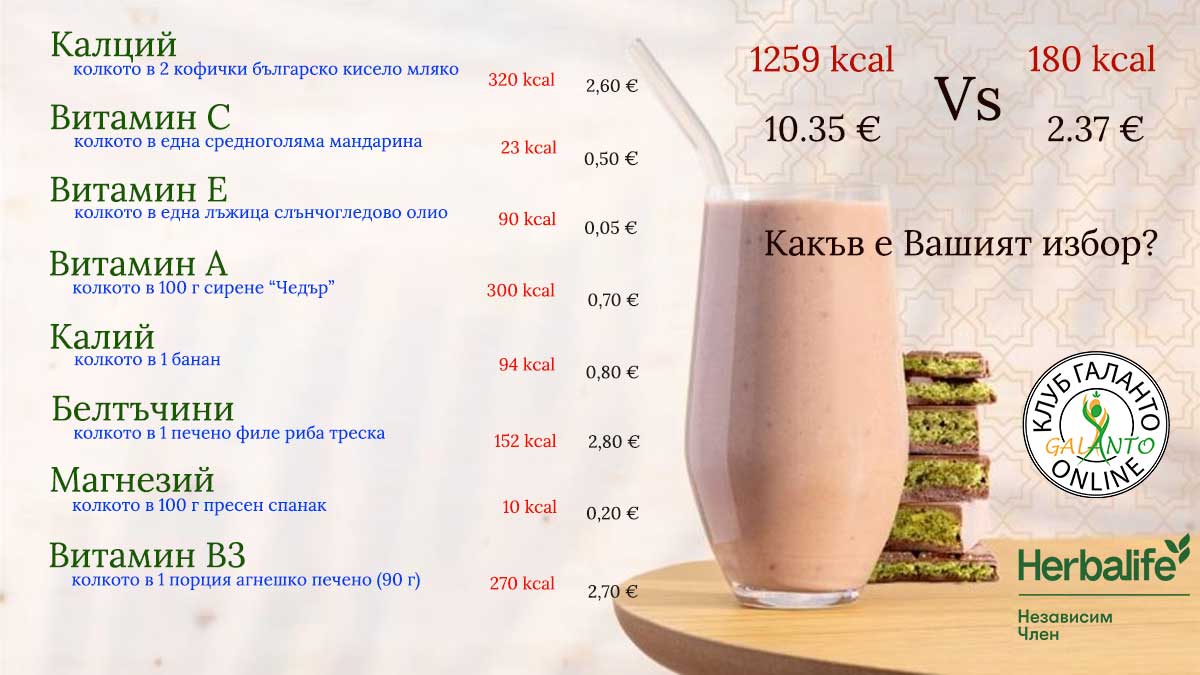
The conclusion is obvious: An “unhealthy” day often costs more!
To get the full range of proteins, trace elements, calcium, vitamin C, magnesium and fiber from conventional food in one meal, you will need over 1000–1300 kcal and a solid amount for shopping and preparation plus an indefinite time searching for quality products without a certain result.
At the same time, one serving of Herbalife Formula-1 balanced shake provides you with all this in about 200 kcal and at a price competitive with the most ordinary coffee and biscuit, and it is prepared in less than a minute.
And the workouts?
“I don’t have money for a gym membership and a personal trainer.”
The gym is a great place, but it’s not the only place to exercise.
- Walking and running in the park are free.
- Working out with your own weight at home is free.
- Taking the stairs instead of the elevator is free.
- Walking to work or at least to a more distant stop is also free.
Health does not require luxury equipment, but regularity.
Change your value system
Spending time and money on your health is not an expense. It is the highest-yielding investment you can make.
- It’s time to stop treating our bodies like “trash cans” into which we throw ultra-processed foods.
- It’s time to get off the couch and feel the possibilities of our own bodies.
- It’s time to stop washing our minds with negativity and gossip, and fill them with goals, dreams and creative energy.
At Club Galanto, we believe that results cannot be bought – they are made with small, everyday choices.
Your Challenge for Today
We challenge you! Share your healthy choice for the day with a loved one today (or in our supportive community).
Accountability and mutual support are the keys to building sustainable habits when motivation wanes. We are here to support you every step of your Wellness CompassGT!
Bibliographic Reference
- Drewnowski, A., & Specter, S. E. (2004). Poverty and obesity: the role of energy density and energy costs. The American Journal of Clinical Nutrition, 79(1), 6-16. (A study on the financial paradox of choosing calorie-dense versus nutrient-dense foods and the economic mechanism behind them).
- Heber, D. (2010). The Biology of Human Starvation and Protein Nutrition. Center for Human Nutrition, UCLA. (Research papers by Dr. David Heber – Chairman of the Scientific Advisory Board of Herbalife Nutrition, on the role of high-quality protein and functional meal replacements in weight management).
- World Health Organization (WHO). (2020). Fiscal policies for diet and the prevention of noncommunicable diseases. World Health Organization. (A World Health Organization analysis of the long-term economic benefits of prevention and healthy lifestyles versus subsequent health care costs).
- Hall, K. D., et al. (2019). Ultra-Processed Diets Cause Excess Energy Intake and Weight Gain: An Inpatient Randomized Controlled Trial of Ad Libitum Food Intake. Cell Metabolism, 30(1), 67-77. (Clinical study demonstrating how impulsive consumption of ultra-processed fast foods leads to imperceptible overeating and hormonal imbalance).
- Patterson, R. E., & Sears, D. D. (2017). Metabolic Effects of Intermittent Fasting and Meal Timing. Annual Review of Nutrition, 37, 371-393. (Study on the influence of proper eating windows and insulin sensitivity).
