



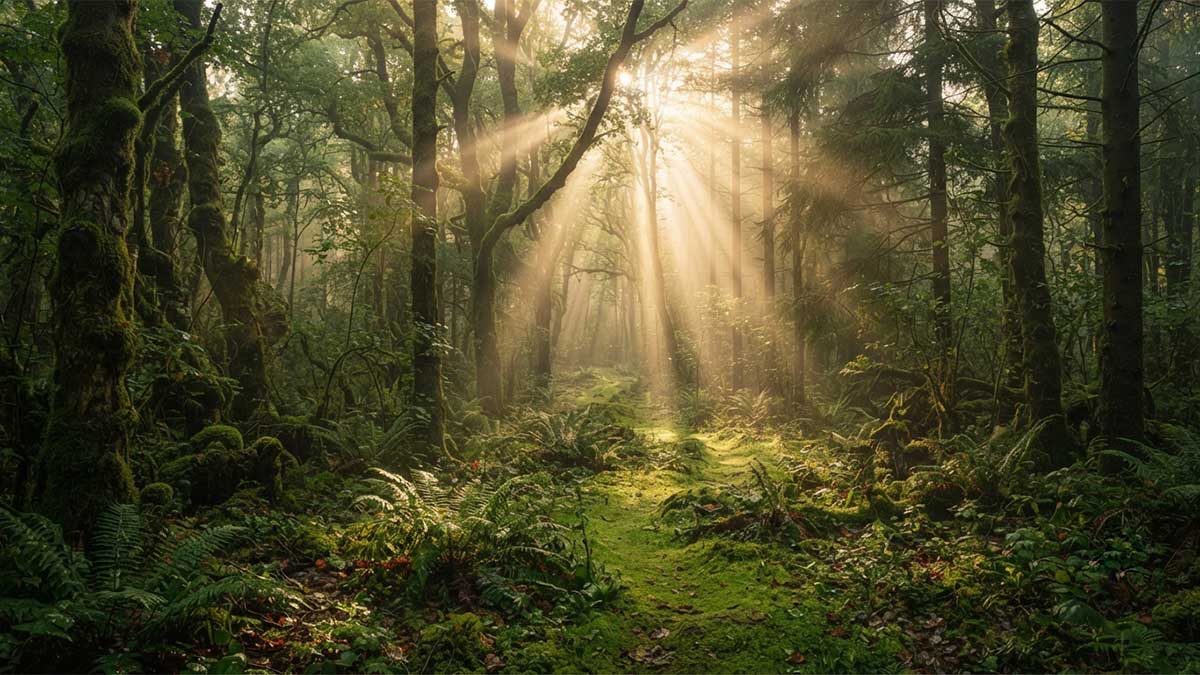
Shinrin-Yoko
🌲Shinrin-Yoko
The Japanese Art of “Forest Bathing” for Zero Stress and Super Immunity
In the modern world of “eternal online connection”, city noise and toxic stress levels, we often forget where our true home is. At Club Galanto, we believe that health is not just on the plate or in the gym – it is in harmony with nature.
Today we present to you an ancient, yet modern, and scientifically proven concept that can transform your health without costing a dime: Shinrin-Yoku, or the Japanese art of Forest Bathing.
🧘♀️ What exactly is Shinrin-Yoku?
When they hear the term for the first time and know the literal translation, many people smile. “Bathing” in the forest? No, it’s not about swimsuits, soap, or swimming in icy rivers.
“Forest bathing” is a metaphor for total sensory immersion in the atmosphere of nature.
The term is made up of two Japanese words:
- Shinrin = Forest
- Yoku = Bathing / Immersion / Shower
It is a practice in which we consciously slow down, turn off our digital devices, and allow the forest to “wash” us away from our daily worries. It is a slow, meditative walk, where the focus is on the here and now.
🔬 The Origin: How a Government Program Saved the Nation
The Shinrin-Yoku concept originated in Japan in 1982. It is not a hippie fad, but the creation of the Japanese Ministry of Agriculture, Forestry, and Fisheries.
At the time, Japan was experiencing an unprecedented technological boom. But the price of progress was high:
- People were working overtime in front of screens.
- Burnout, chronic stress, and suicide rates were skyrocketing.
To save public health, the government launched a national wellness program based on something very simple: getting back to nature. They created special Shinrin-Yoku trails, certified them according to medical criteria, and encouraged people to spend time there. The results were astounding.
🌿 The Science Behind Magic: How the Forest Heals?
Why is being in the forest so different from walking in the city? The answer lies in biochemistry.
🧪 Phytoncides: The Natural Immune Booster
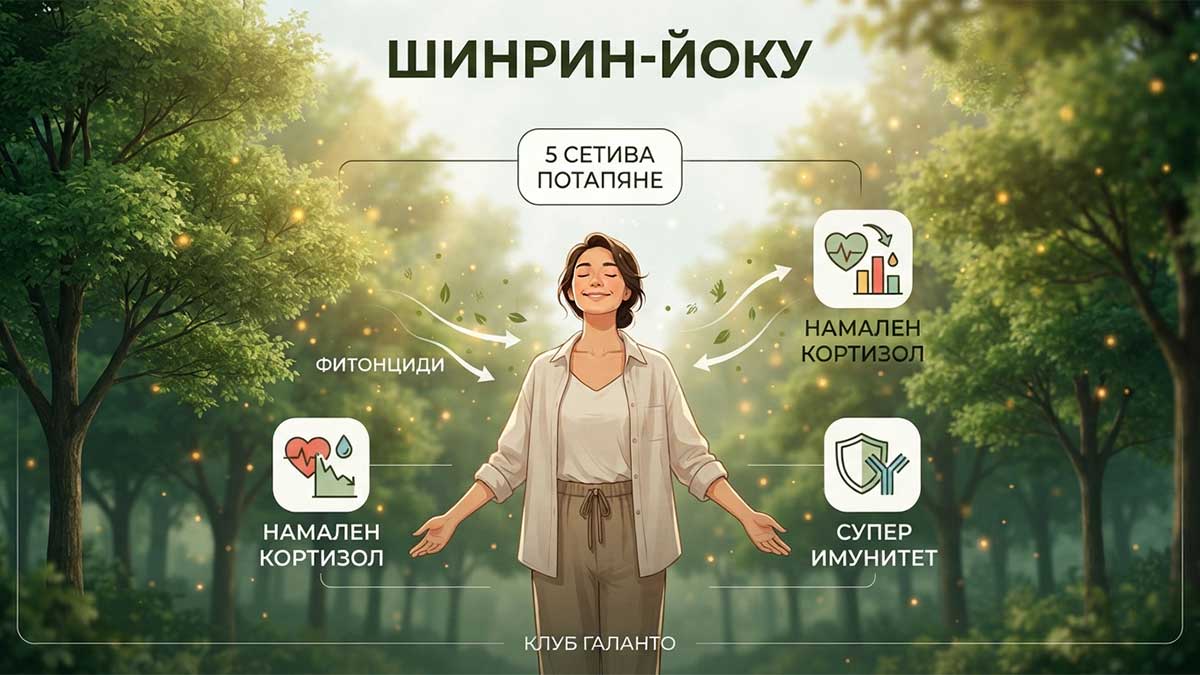
Trees emit aromatic compounds called phytoncides to protect themselves from insects, fungi, and pathogens. When a Shinrin-Yoku practitioner walks slowly and inhales these phytoncides, they enter their body.
Science proves that inhaling phytoncides leads to:
- Dramatic decrease in cortisol (the stress hormone).
- Increase in the activity of NK cells (“natural killer cells”), which are key to our immune system in the fight against viruses and pathogens.
- Lowering blood pressure and slowing the pulse.
🧘♂️ Practical guide: How to do Shinrin-Yoku?
This is not a sports run or a quick hike with a backpack to the top. Here the goal is in itself. When we do Forest Bathing at Club Galanto, we activate all 5 senses:
👀 1. Eyes (See Komorebi)
Look at the green wall that surrounds you. Notice how the sunlight plays between the leaves – that’s why the Japanese have a special word: Komorebi. Observe the moss, the small details on the bark. Studies show that even just looking at natural forms reduces inflammation in the body.
👂 2. Ears (Hear the silence)
Stop for a minute. Listen to the sound of the wind in the crowns, the distant chirping of birds, the crack of a dry branch under your feet. Allow these sounds to fill your mind.
👃 3. Nose (Inhale the phytoncides)
Take a deep, conscious breath. Smell the wet earth, the pine resin, the wildflowers. This is the moment when your body “bathes” in the healing phytoncides.
✋ 4. Skin (Feel the coolness)
Stop and touch. Run your hand along the rough bark of an ancient tree or along the soft carpet of moss. Feel the coolness of a shady meadow or the light, warm wind in an open position.
👅 5. Taste (Drink the fresh air)
Yes, the air has a taste! Drink the fresh air with an open chest. You can even stop and make yourself an herbal tea outdoors (e.g. from forest herbs, if you know them, or just carry a thermos). This completes the sensory immersion.
Shinrin-Yoko
🏁 Summary and Practice
Your Green Restart Mission
Time spent in nature is not wasted time – it is the smartest investment in your immunity, mental health and youth.
Your Mission:
As soon as you read this article (and if your life allows it), take 30 minutes. Turn off your phone. Find the nearest park, garden or forest. And just “immerse” yourself in the green atmosphere.
Your body and mind will thank you!
There is certainly a place in your city where you can practice Shinrin-Yoku. I know many places in Sofia, but I will deliberately not name them. Share in the comments places that you consider suitable for Shinrin-Yoku!
Your like-minded people will thank you too!
📚 Bibliography
(Selected key studies and authors who laid the foundations of “Forest Bathing”)
-
Li, Q. (2018). Shinrin-Yoku: The Art and Science of Forest Bathing. Penguin Life. (Dr. Qin Li is one of the world’s experts who proves the connection between phytoncides and immune NK cells).
-
Miyazaki, Y. (2018). Shinrin-Yoku: Japanese Forest Bathing. Timber Press. (Dr. Yoshifumi Miyazaki is a pioneer in the study of the effect of the forest on cortisol and the nervous system).
-
Hansen, M. M., Jones, R., & Tocchini, K. (2017). Shinrin-Yoku (Forest Bathing) and Nature Therapy: A State-of-the-Art Review. 14(8), 851. (Complete academic review of dozens of studies on health benefits).
-
Uehara, I. (2010). The Psychological and Physiological Effects of Forest Environments. In Advanced Technologies. IntechOpen. (Japanese study investigating how forests treat anxiety).
-
Park, B. J., Tsunetsugu, Y., Kasetani, T., & Miyazaki, Y. (2010). The physiological effects of Shinrin-yoku (taking in the forest atmosphere or forest bathing): evidence from field experiments in 24 forests across Japan. class=””>, 15(1), 18–26. (One of the seminal studies that demonstrated the drop in cortisol).
